The earliest ethnomycological evidence so far identified was found in a cave engraving in the South-East of Algeria and it dates back to a period between 9,000 and 7,500 BC: it depicts figures in motion, holding a mushroom in their right hand.
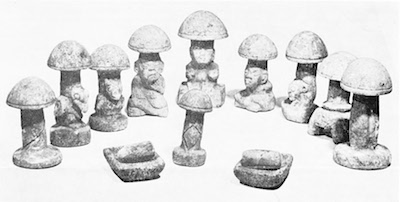
The most significant artifacts related to mushrooms are certainly rocks known as mushroom-stones which were found during archaeological excavations in various sites in Guatemala and Southern Mexico. Over two hundred items have been classified as mushroom-stones, coming from Central America, mostly dating back to the Mayan age and area, usually interpreted as intentional representations of hallucinogenic mushrooms.
In Southern India, mushroom-shaped prehistoric megalithic constructions are traced back to the first millennium BC.
In the Ötztal Alps, the 'Similaun Mummy' also known as 'Ötzi' dates back to 3300/3200 BC: it was found in 1991 with both a specimen of Piptoporus betulinus (showing antibiotic and vermifuge activity) and Fomes fomentarius.
In Greek literature there are numerous references to edible and poisonous mushrooms, for which the Greeks elaborated an articulated terminology. Theophrastus, who lived between the 3rd and the 2nd Century BC, identified the hydnon, underground mushrooms, the mykes, terricolous fungi with a cap and a stem, the keraneon (keraunion), head-shaped - perhaps puffballs - and the pezes (pòxos), sessile and hollow-shaped mushrooms.
Pliny the Elder, of the 1st century AD, reported the first reference in Western literary documentation related to the Amanita muscaria writing that some "show white drops on their top as if they were pushing out".
In the history of ethnomycology we find relevant information regarding a minor fungus, a parasite of the spikes of numerous wild and cultivated grass families: the ergot, otherwise known as horned rye. The sclerotia of this fungus are rich in indole alkaloids, from which Hofmann synthesized LSD in 1938.
Great evidence of the therapeutic use of mushrooms comes from the East, from the Traditional Chinese Medicine (TCM) of Taoist tradition, with a 4000-year old history of clinical practice.
Mushrooms have been used in TCM for millennia, both as food and medicine.
The first evidence on the use of Mushrooms in TCM dates back to the Shen Nong Ben Cao Jing Treatise (Divine Farmer's Materia Medica) written in 250 BC. Natural remedies are divided into 3 classes, the most important of which consists of 120 substances to be used "in order to make your body light, increase qi, prevent aging and prolong life".
Several mushrooms belong to this "upper class" including: Ling Zhi (or Reishi or Ganoderma lucidum), Zhu Ling (or Chorei or Polyporus umbellatus), Fu Ling (or Bukuryo or Poria cocos), Dong Chong Xia Cao (or Tochukas or Cordyceps sinensis).
Many of the mushrooms used today are known by their corresponding Japanese names, in which the suffix "take" means "mushroom".